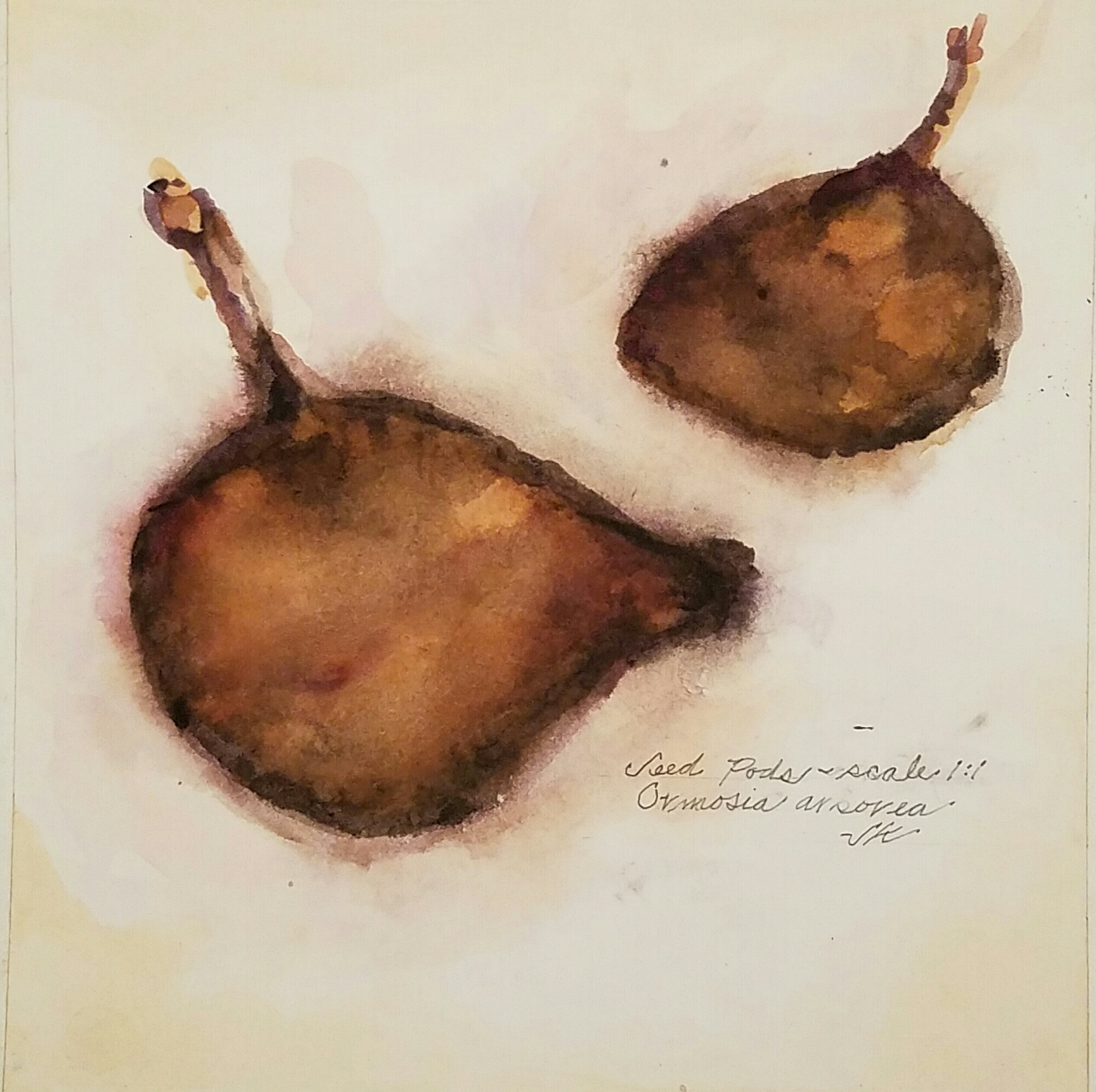
Seed Pods – Ormosia arborea, 8×8“, watercolor, 2016
Seed Pods – Ormosia arborea, 8×8“, watercolor, 2016
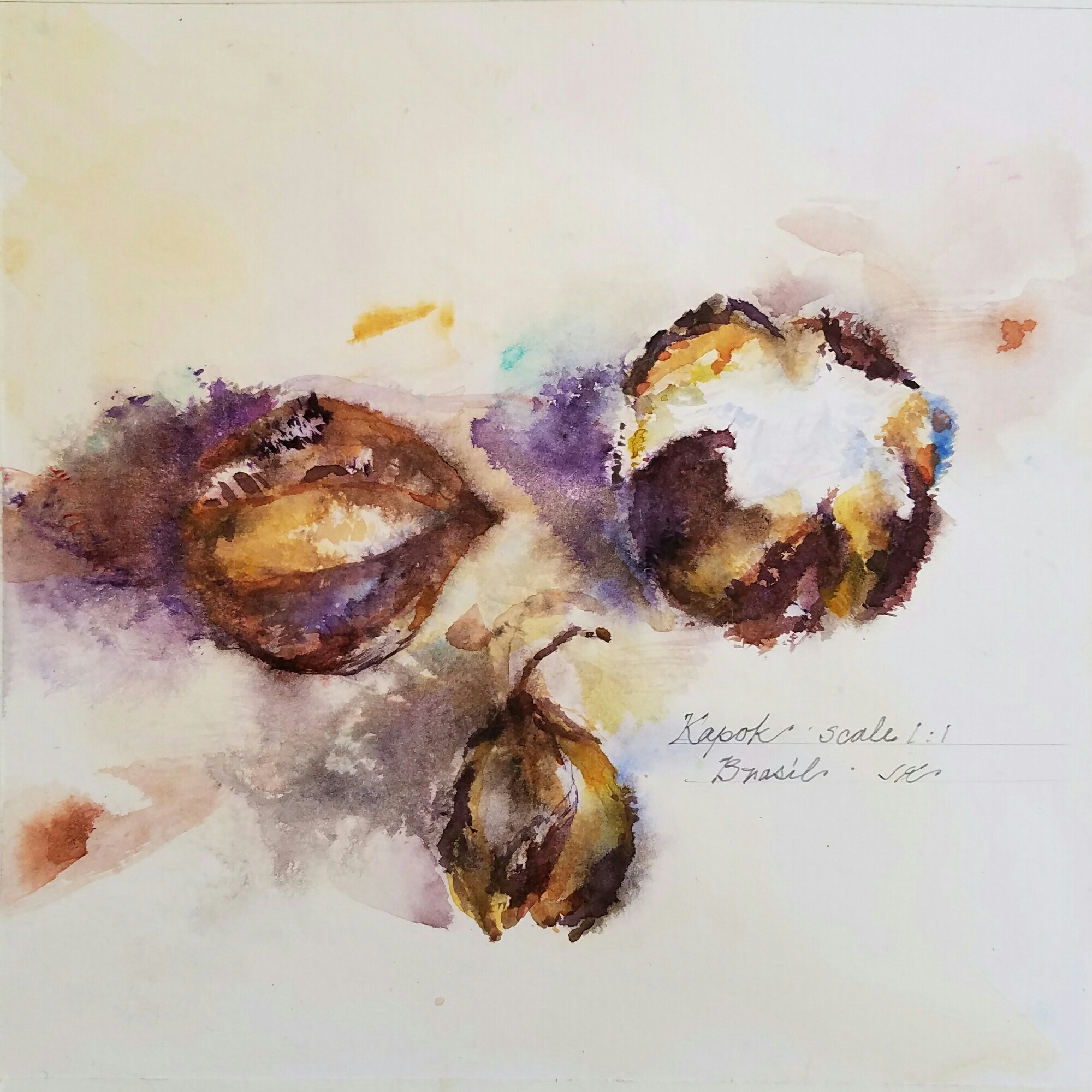
Cochlospermum gillvraei Benth., 8×8″, watercolor, 2016
http://www.dailypaintworks.com/buy/auction/624696
These seed pods grow on a tree, Bixaceae Cochlospermum gillivaei, a yellow flowered species common in Brasil, hailing from Australia. I haven’t determined its common name yet. Not being a botanist myself, I’ll offer the caveat that the above information might be wrong.
When I see a plant that interest me I take a photo. Then I paint it. Afterwards, I look through the three botany books I bought when I got to Brasil. If I can’t find a photo that matches my painting, I head for Google and search with words, then search the ‘Images’ that result. I scroll through pics, sometimes hundreds, til a visual match shows up. I then follow links that give me the name and characteristics of the object I painted.
So… there’s plenty of room for error in my research methods. However, I have a limited amount of time to spend ferreting out info, especially when it absorbs time I might otherwise spend painting. I have a curious, not scientific, mind. My botanical paintings deal in generalities, neglecting minutia.
I’m okay with that.
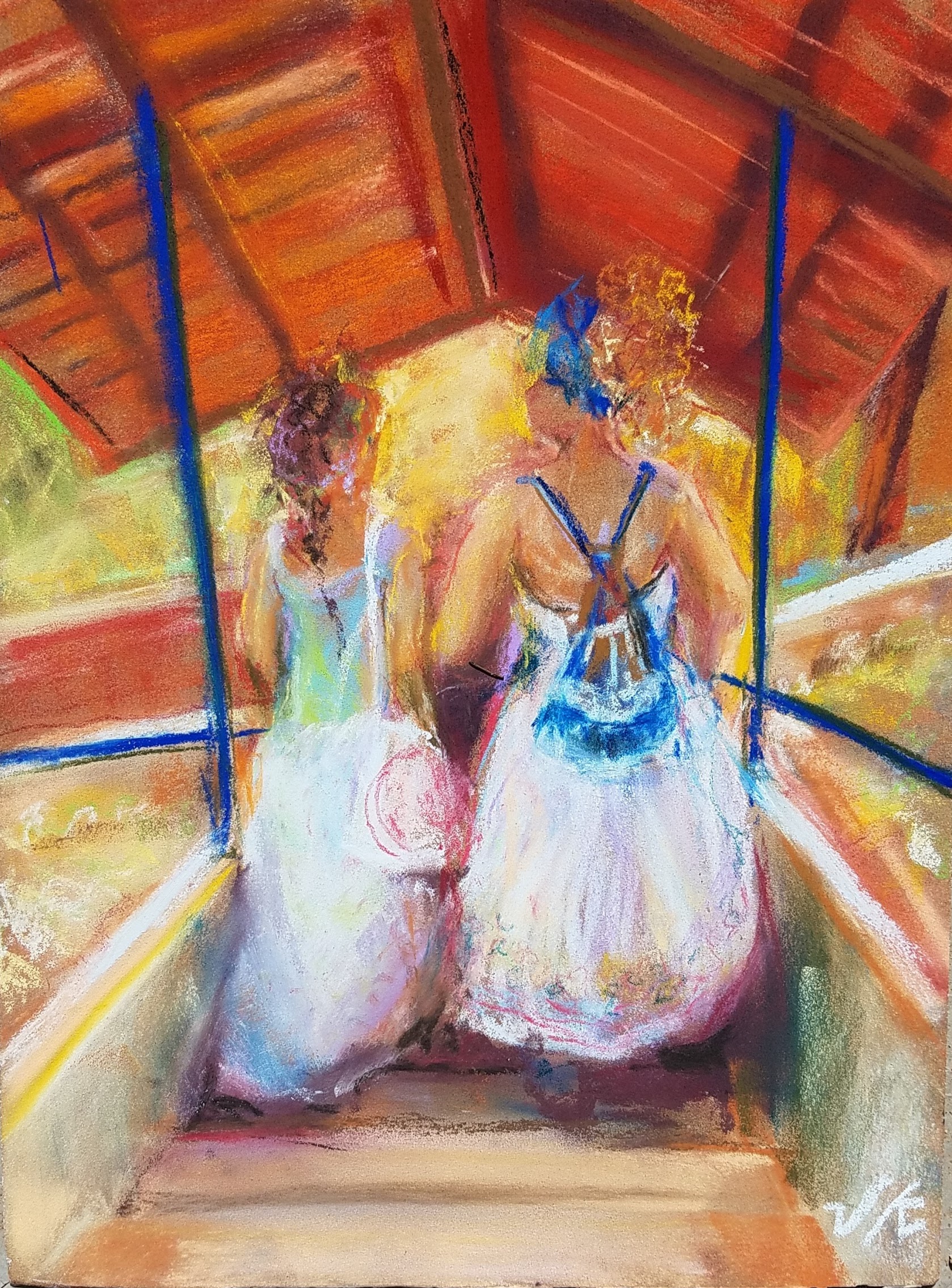
Mulheres do Trópico de Capricorn, 12×9″, pastel
The sunlight in the Tropic of Capricorn is blinding, saturating all it settles upon. There’s a lot of ambient environmental red and orange from the tawny clay earth to the baked tile roofs. Trees and plants scream green and yellow, the sky vibrates blue and indigo. It’s astoundingly opulent.
And it’s hot, best to wear light, loose cotton that billows and cools in the breezes. The women in the painting are students at Unicamp in Campinas, SP, Brasil, going to class. Much of the campus has covered walkways protecting from sun and frequent rain.
So the blinding sun, all the red and orange, the sheltered paths and young women in flowy white pastel garments is the reason for this painting. That’s reason enough, no need to go deeper.
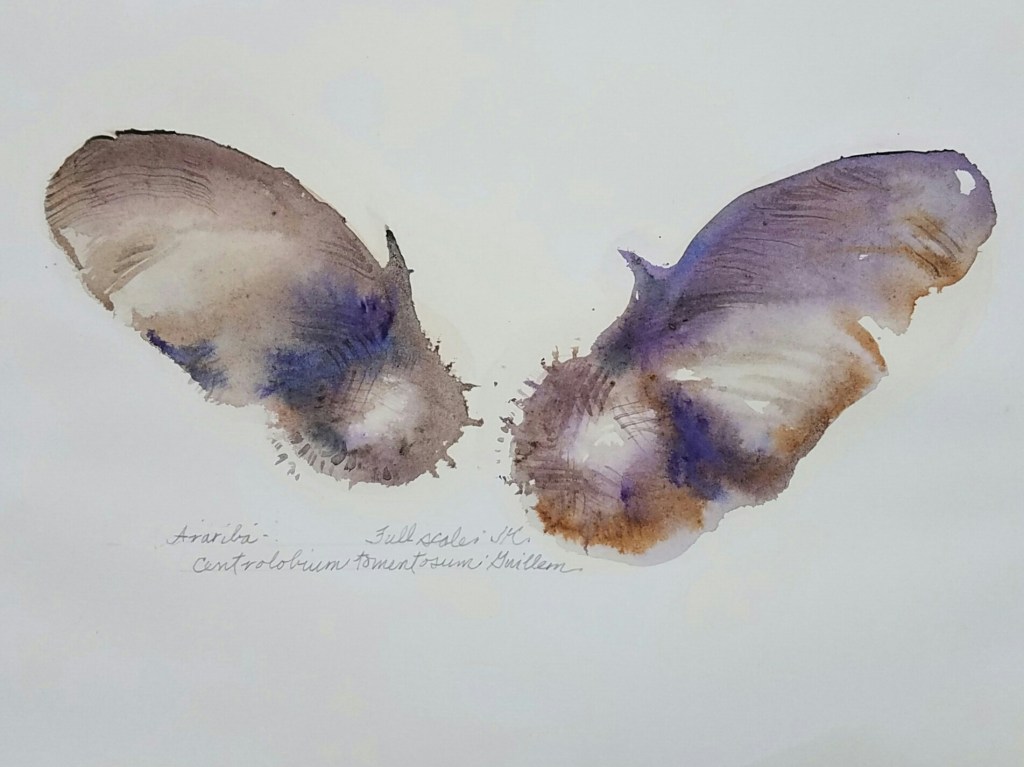
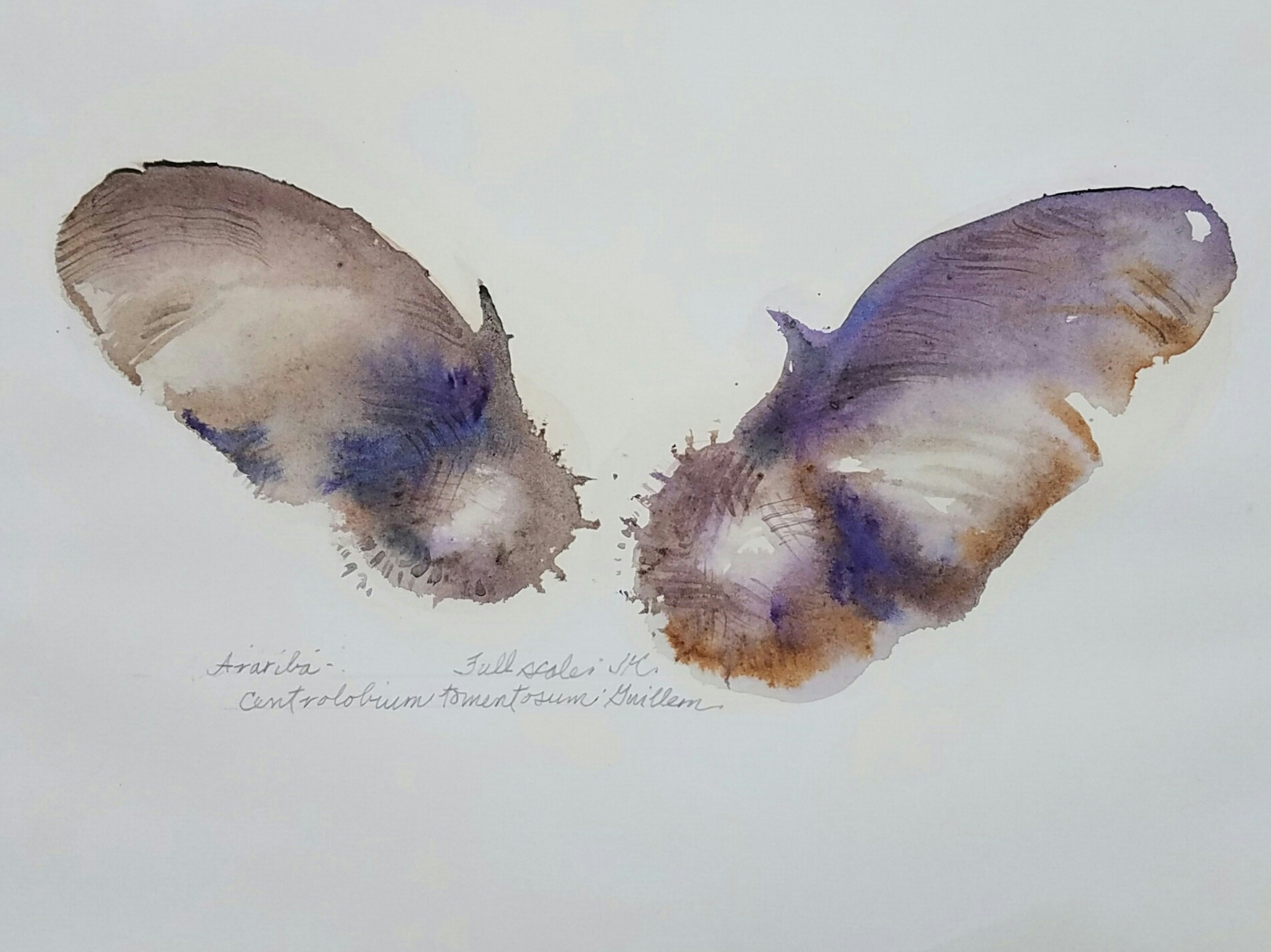
Arabiba, 12×9″, watercolor on 14O # Paper
These winged seeds come from a tree which can grow to over 100 feet in height. In Brasil the tree is used extensively in reforestation projects, urban landscaping and for its ornamental wood. The yellow flowers become really large, 4-6″ whirly-gig units which are blown far and wide. The seeds also have pickery spines that cling to fur, clothes or wherever they can get a grip. I painted these as part of an ongoig study of seeds, my interest in these being their enormous size. These are painted full scale.
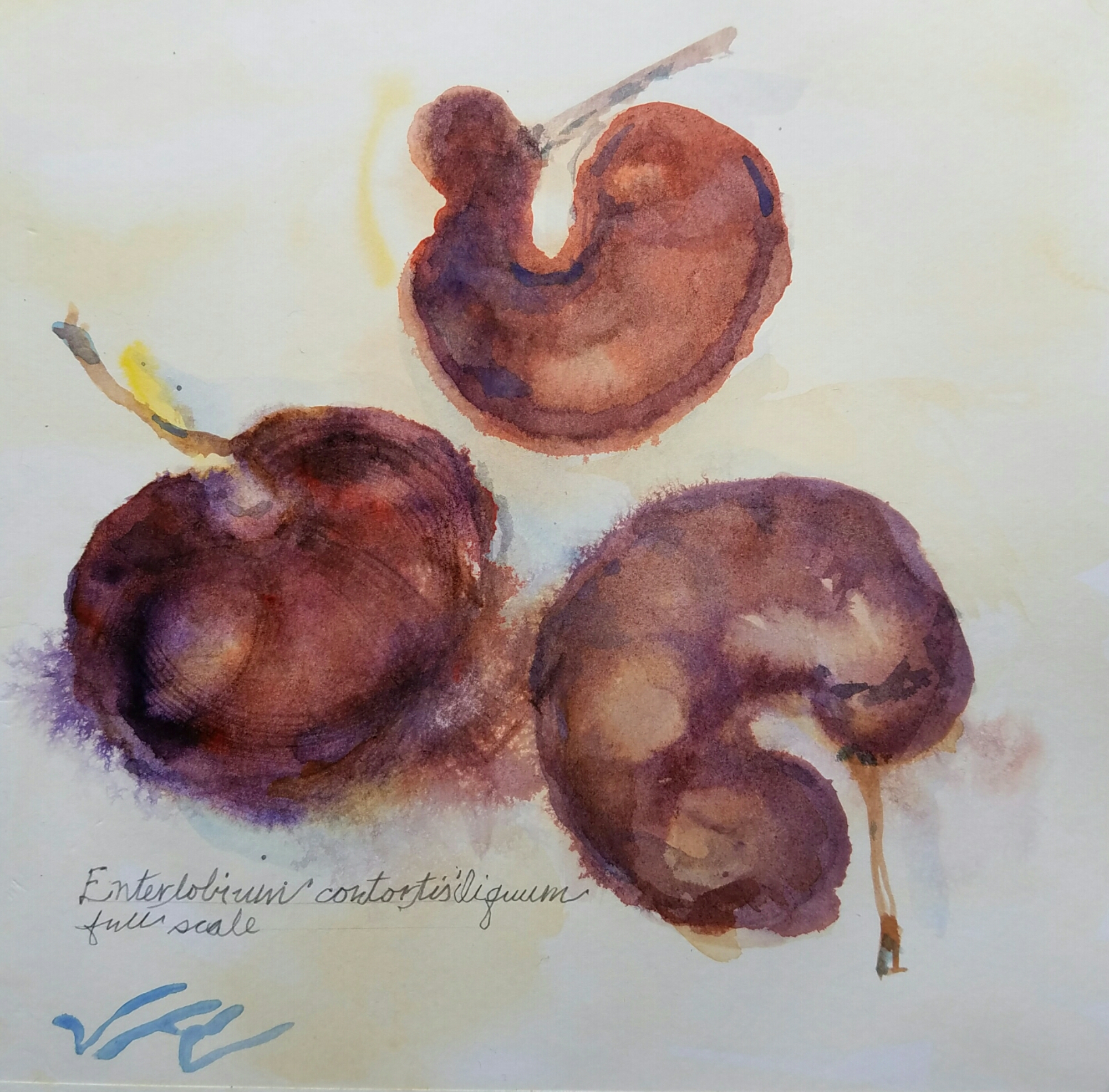
Tamboril, 8×8″, watercolor on 140# HP paper
The tamboil tree goes by many names, most of which are associated with its ear shaped seed pods. Scientifically it belongs to the Fabaceae family and is named Enterolobium contortisiliquum. They’re native to Brasil. They can reach 20-40 meters in height giving welcome shade. The wood is used for furnishings, the bark which is high in tannin is used in learher industries.
The seed pods have a wonderful, pouchy shade with a have a rattle when jiggled!
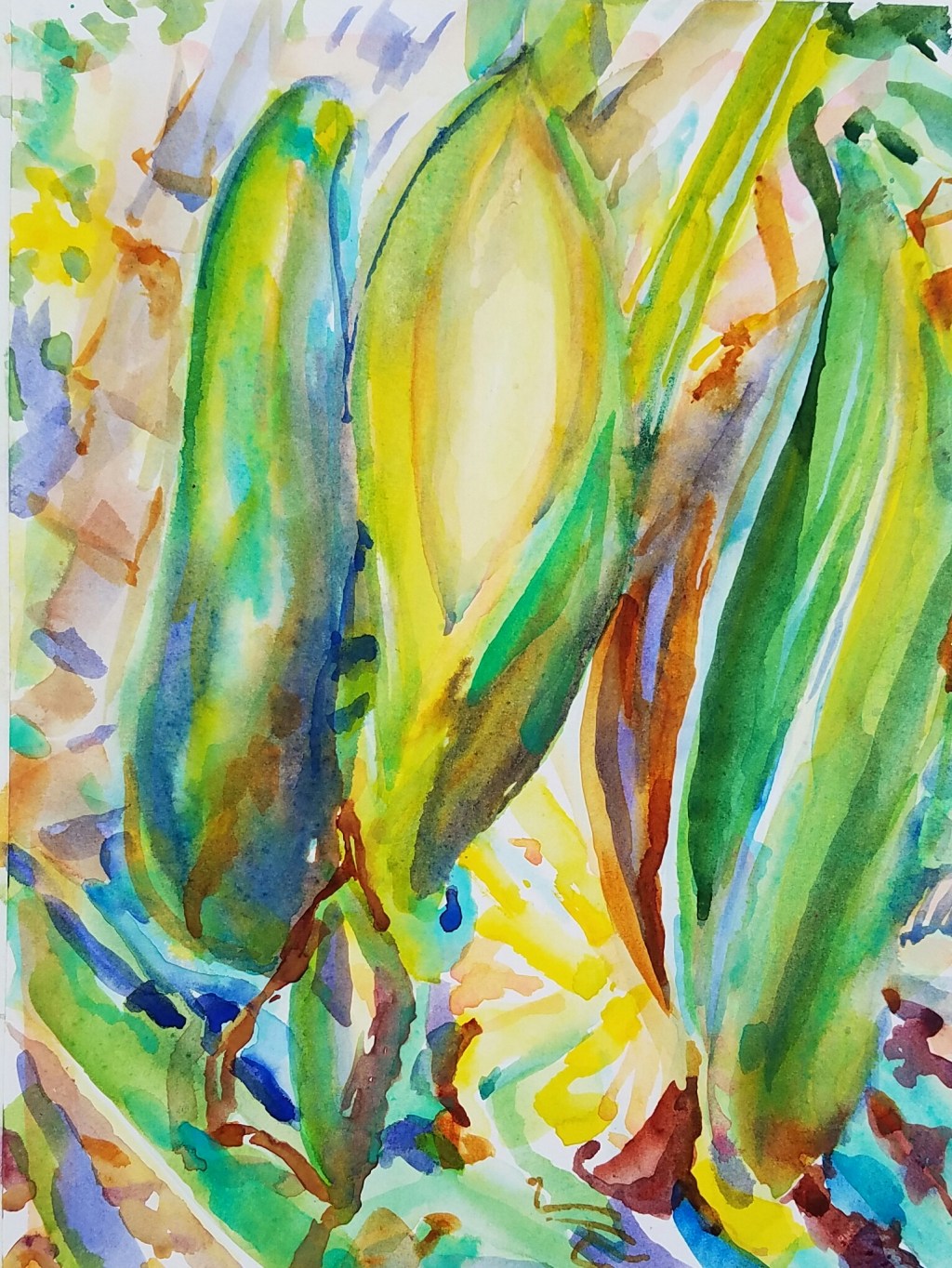
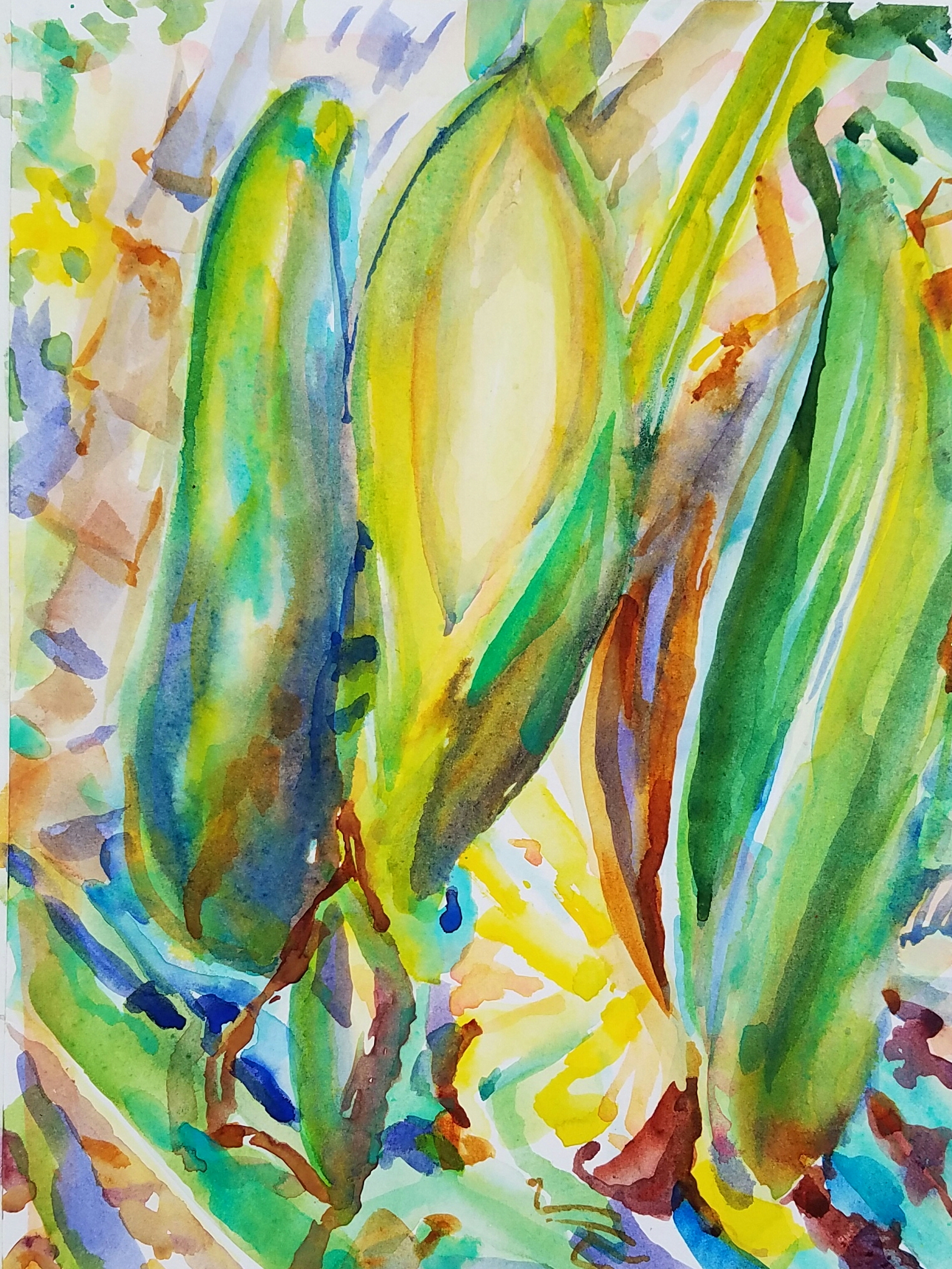
Philodendron, 12×9″, watercolor on 140# HP paper
If you are a philodendron, the Tropic of Capricorn is where you want to live, not in the upper latitudes clinging to life in an office planter, overwatered, underfed, starved for daylight.
Here the size and variety of this species is vast. Plants which are scrawny potted slips in the US are as big as a house in Brasil, co-habiting with even bigger plants as they climb, coil and wind skyward. Their closed pods are the size of a liter Thermos bottle. When the pod (blossom) opens it reveals a huge ivory anther. After fertilization the blossom closes. Why? I don’t know, yet. I walk past this philodendron daily and always look to see what’s new.
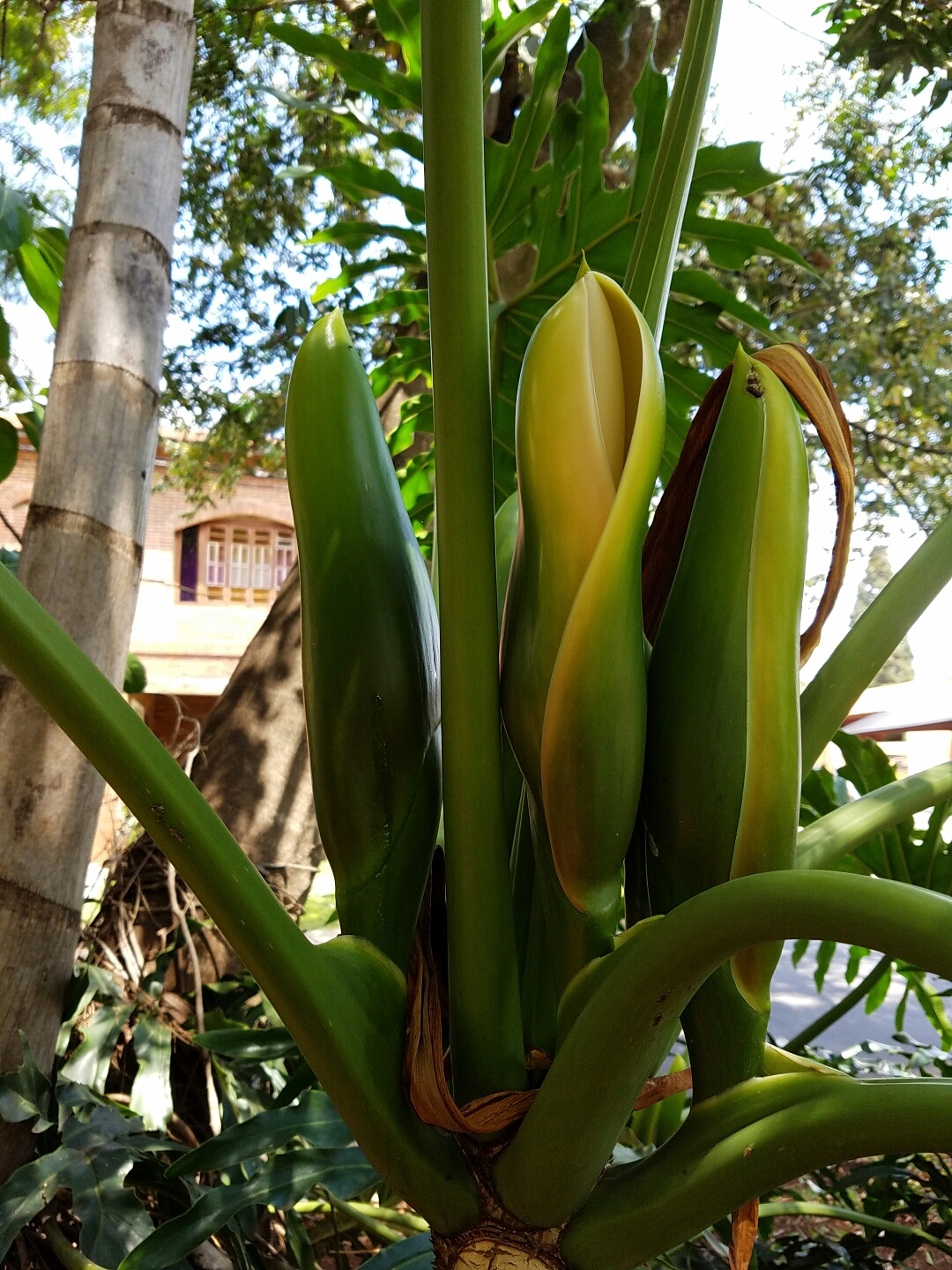
Philodendron Pods
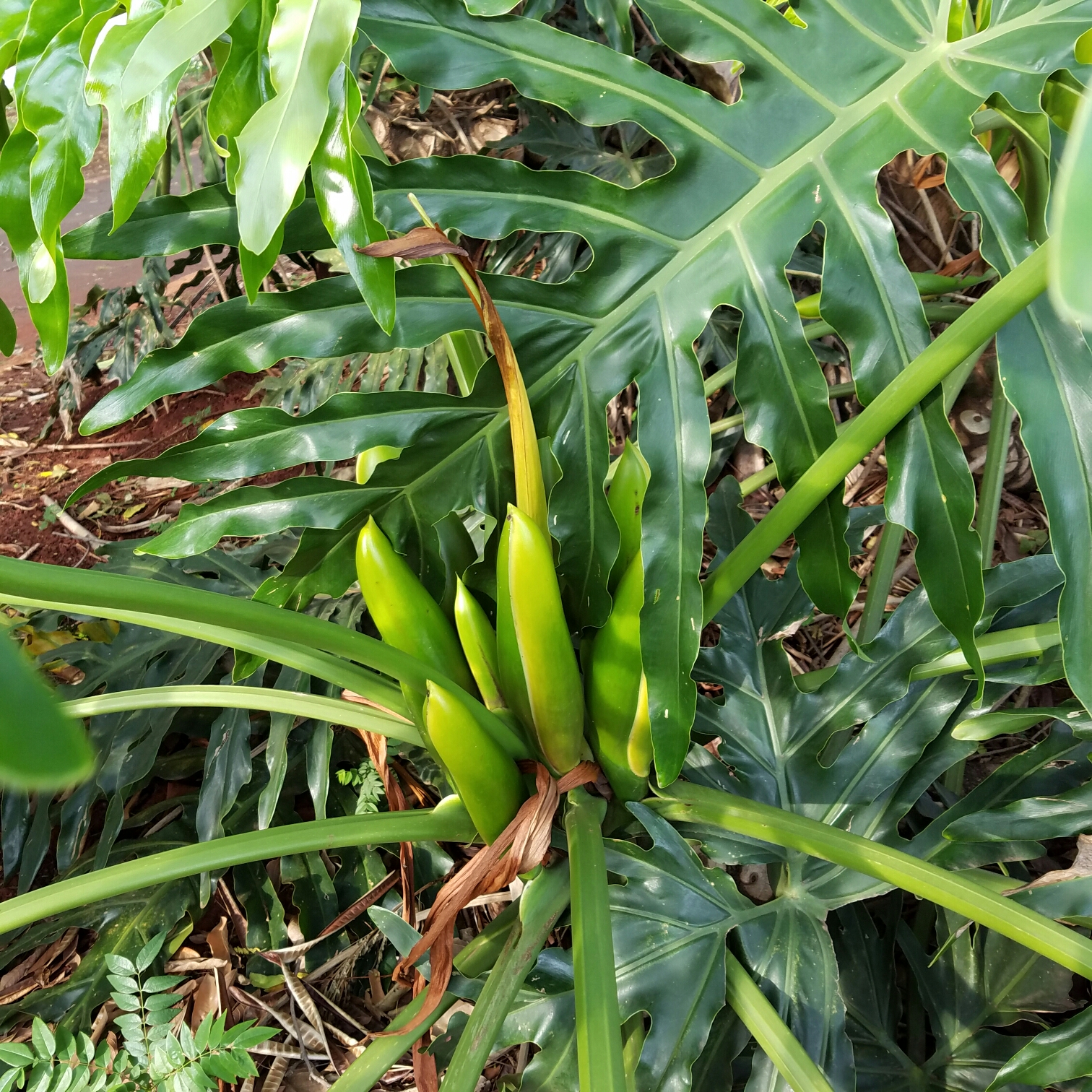
Philodendron Leaves and Pods

Goose Preening, Campinas, Brasil, 12×9″, watercolor on Arches 140# CP
http://www.dailypaintworks.com/buy/auction/619131
Tropical Depression, 20 x 14″, pastel in Arches 140# CP
Being American, being of a nature that celebrates variety and a se la vie attitude towards most matters, I must admit that I had a real sense of depression and loss with regard to the US election results. I’ve been painting this since the day of the election and it took longer than most. I couldn’t find graphic resolution to it’s design. Sorta like I can’t find emotional resolution to why the US electorate had such sorry candidates as presidential nominees.
But it’s done like this painting is done. God bless us all. It is what it is.

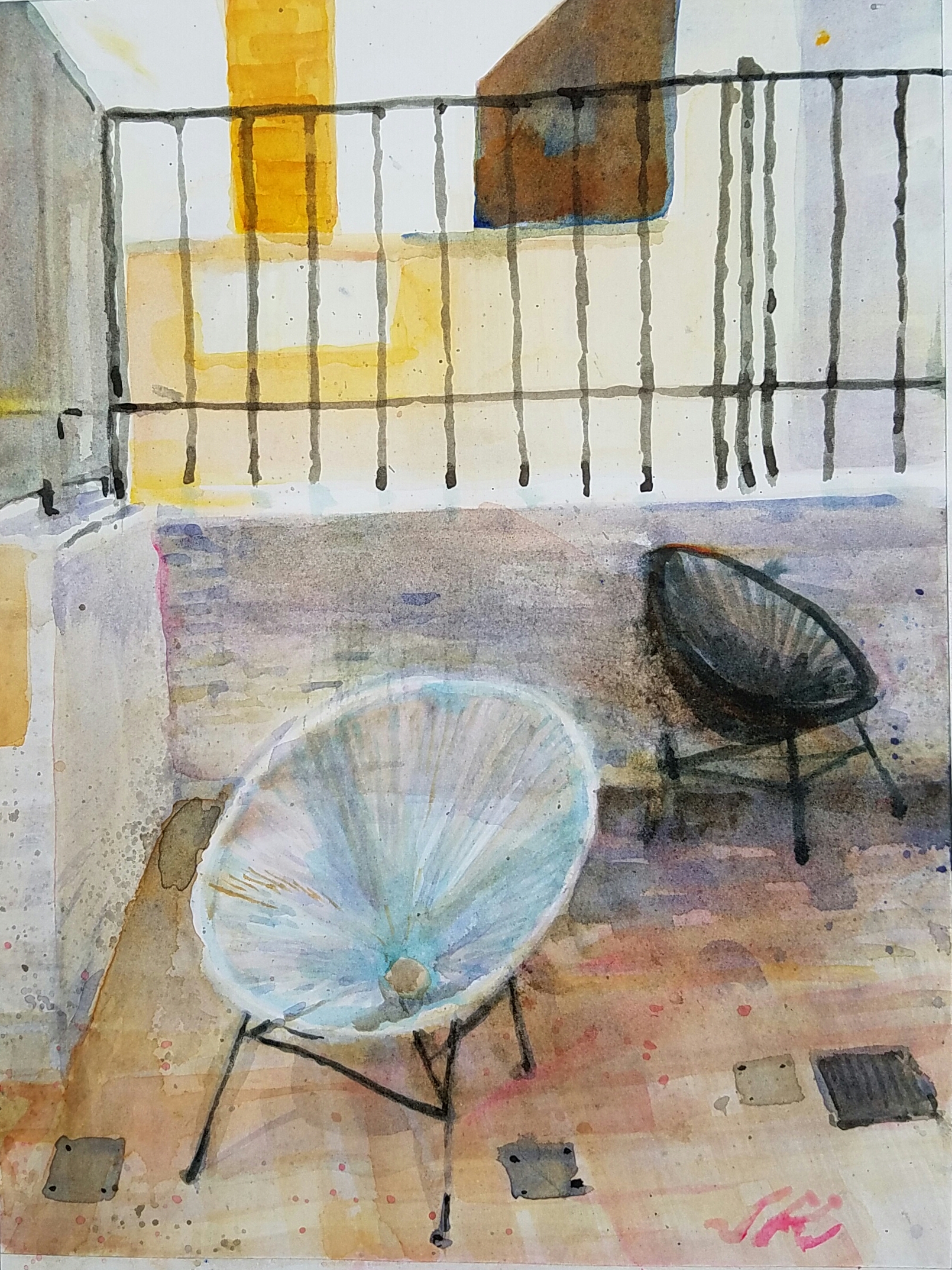
Edwardo’s Patio, 12×9″, watercolor, 2016
Edwardo invited us to dinner last weekend. He has a highrise apartment in downtown Campinas, Brasil. The view’s great from the seventeenth floor and his deck is enormous and totally private. I was caught by the combination of geometry and airy openess and painted it in tribute to built spaces.
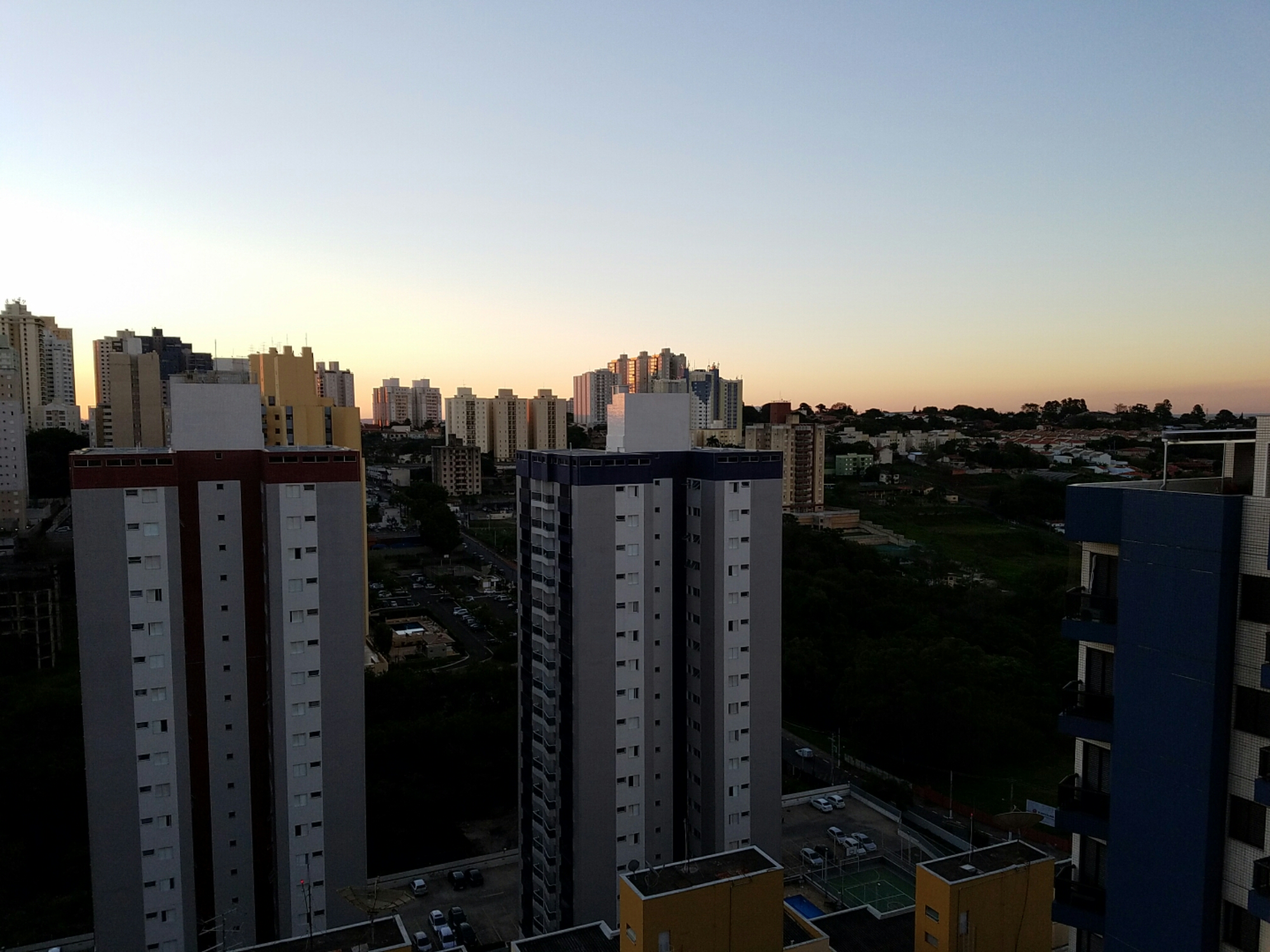
Downtown Campinas, SP, Brasil, looking northwest
We moved closer to the Equator last weekend, landing in Brasilia, 7° north of the Tropic of Capricorn. Ted had some business at the University of Brasilia. His colleagues, our friends, Adson and Diana, showed us around several of the campuses spread far and wide throughout the city.
Brasil is going through political and monetary tough times. Unsurprisingly, the turmoil was evident throughout the city, particularly on campus.
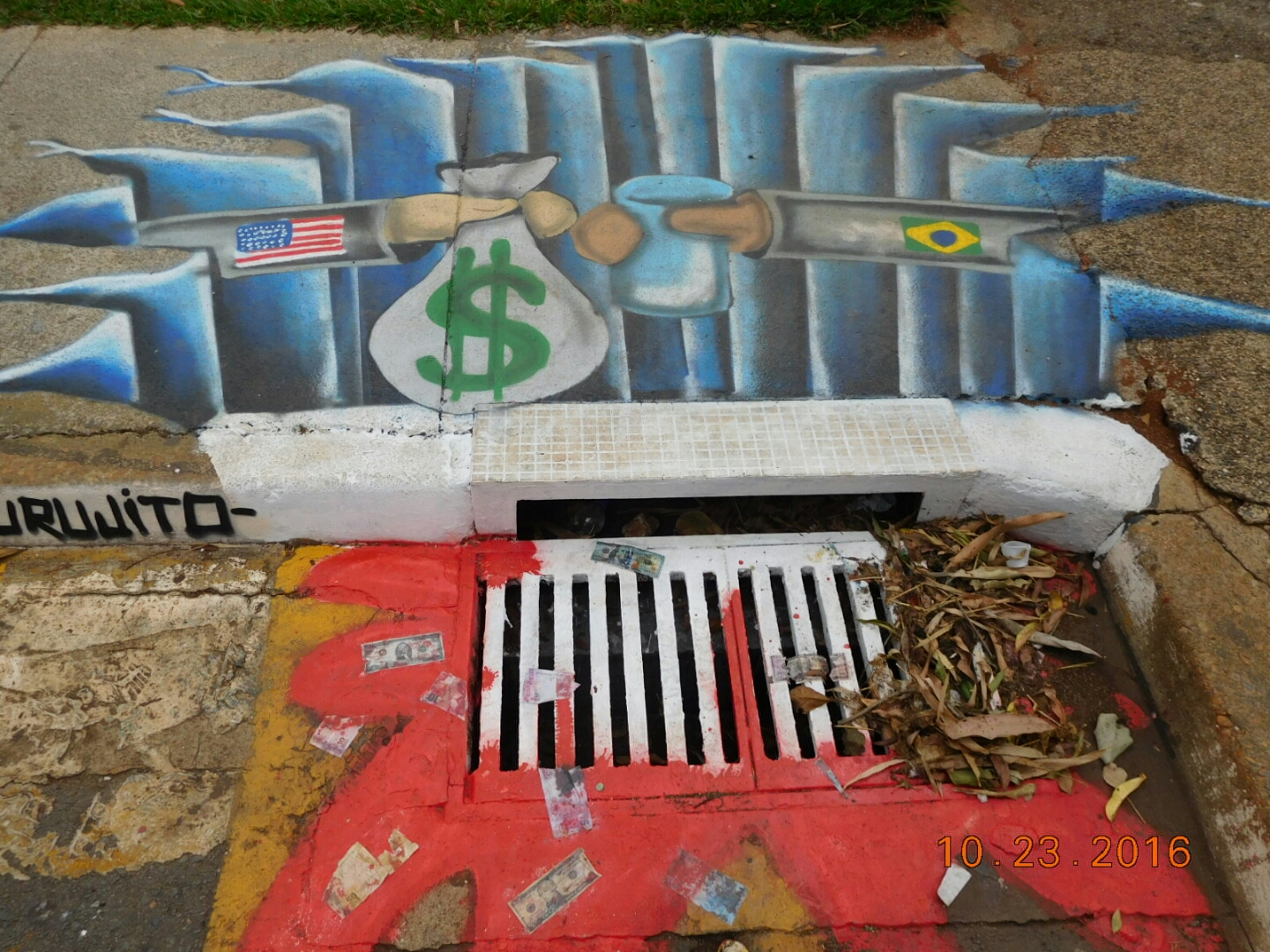 Sidewalk Graffiti, University of Brasil
This red, white and blue sidewalk painting shows the arm of the USA offering a bag of money to Brasil who in turn offers a barrel of oil. These images overlay the great waterfalls of Brasil which turns to blood red as it flows into a sewer drain. Copies of dollars and Brasilian raeyes are glued to surface, pouring with the blood into the drain.
The truth of this matter lies between the Left and Right extremes portrayed in the painting. I was startled when I saw this graffiti. In my book, this painting is good, honest art, nothing less. Salud to the artist.
.
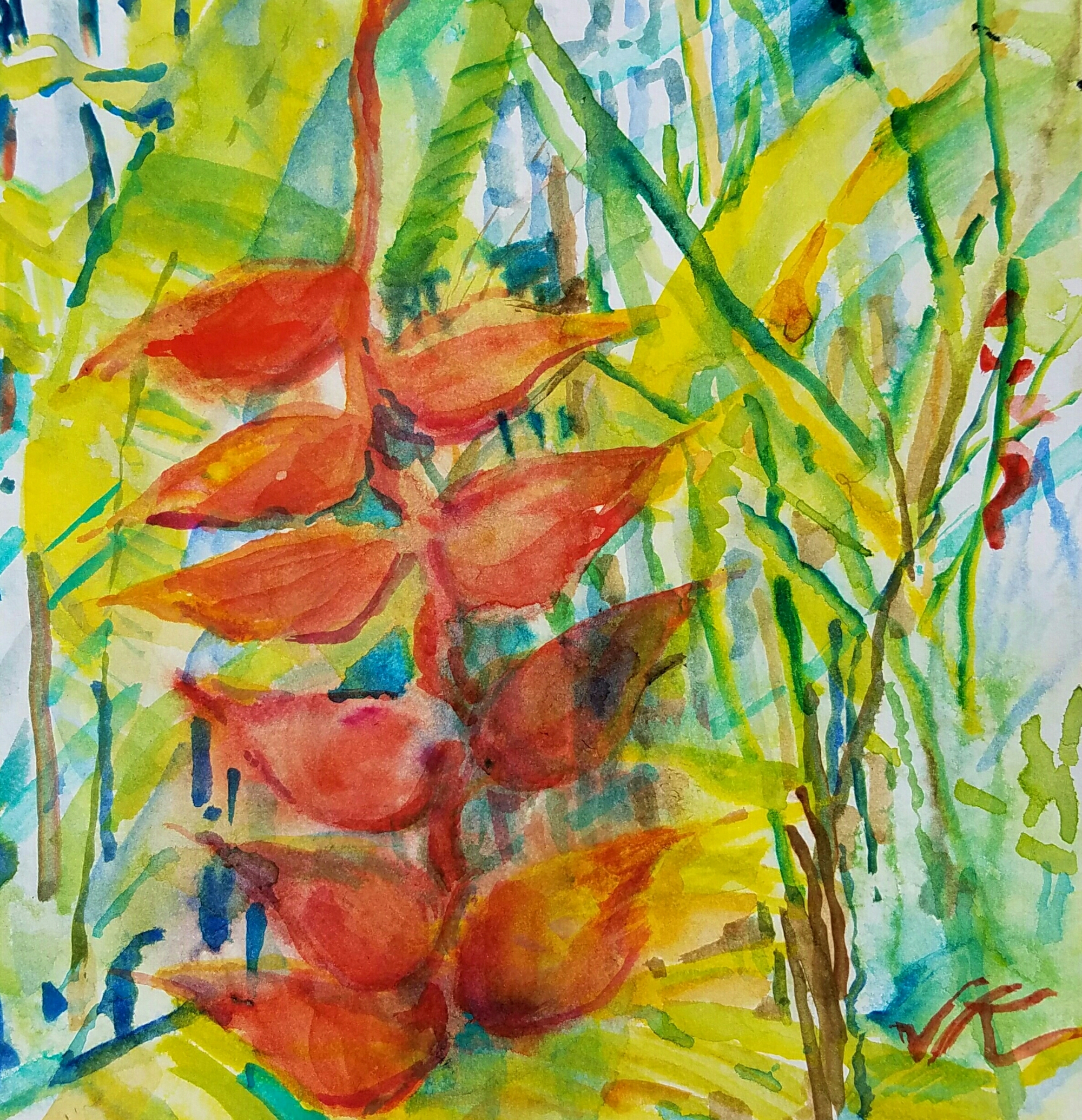
Jardim Botanica, 2016, 8 x 8″, watercolor on 140# CP paper
Ted and I have toured a few major highlights in Brasilia proper the past few days, places honoring the founders of this latest Brazilian state, monuments which commemorate, venerate and relegate these men who once held power to eternal memory. Ashes to ashes and dust to dust.
The botanical garden, Jardim Botanica de Brasilia, on the southwest side of the city provided perspective when compared to the hard built shapes of its Brazilian architect, Oscar Neimeyer. The concrete plazas of greateness are so very hot and thirsty, the garden is cool and quiet, life abounds. A docent, Melissa, student of entomology, explained that bees, her specialty, are threatened and under great environmental pressure due to human activities. She studies at the University of Brasilia.

Melissa, Etomologist
We have met other students, mostly in fields of engineering . Ted gave a couple lectures at the U of BR, which is why we’re in this capital city. Ted teaches design.The gist of both lectures was that when searching for design solutions, identify the true nature of the problem before embarking. Interact with people who have different academic backgrounds to achieve wider vision when designing. The students we met are at the end of undergrad studies and must decide what to do next, pretty scary, I recall.

http://www.dailypaintworks.com/Artists/jean-krueger-5457

Comanch Lake, Custer County, CO, USA

Come and visit my Gallery!
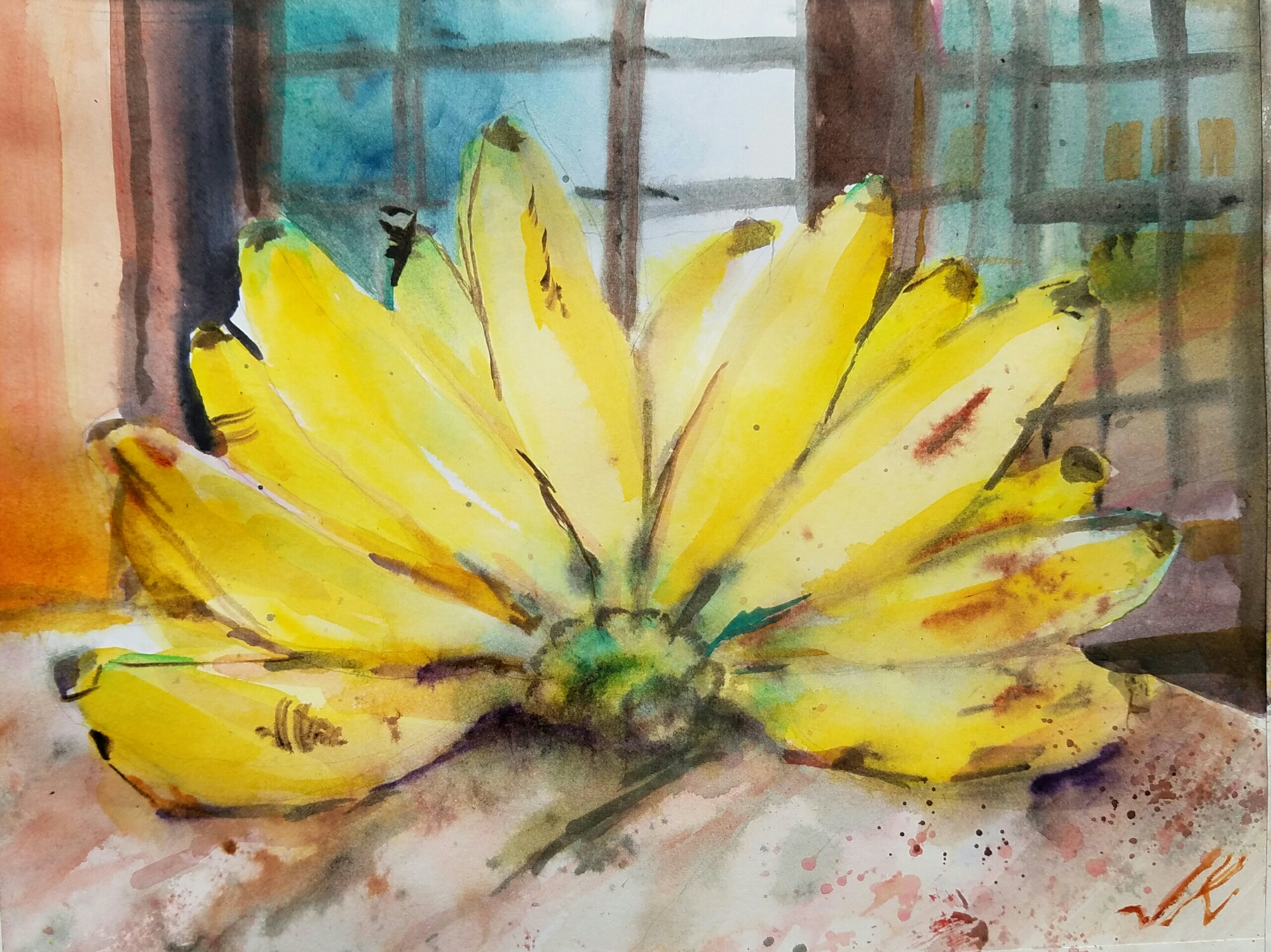
Bananas Ouro, 9×12″, watercolor on 140 # watercolor paper
Here is a tribute to the Gold Banana. It is less than 4″ long, it’s sweet and nutty and irresistible . The last bunch looked like a spikey headdress when arranged just so, sculptural and all realistically abstract. I had to paint them. Now all that remains of the bunch is a sweet memory and this full-size painting.
Sweet memories is what I paint and why I do it….they will be all that is left when I cease to remain .
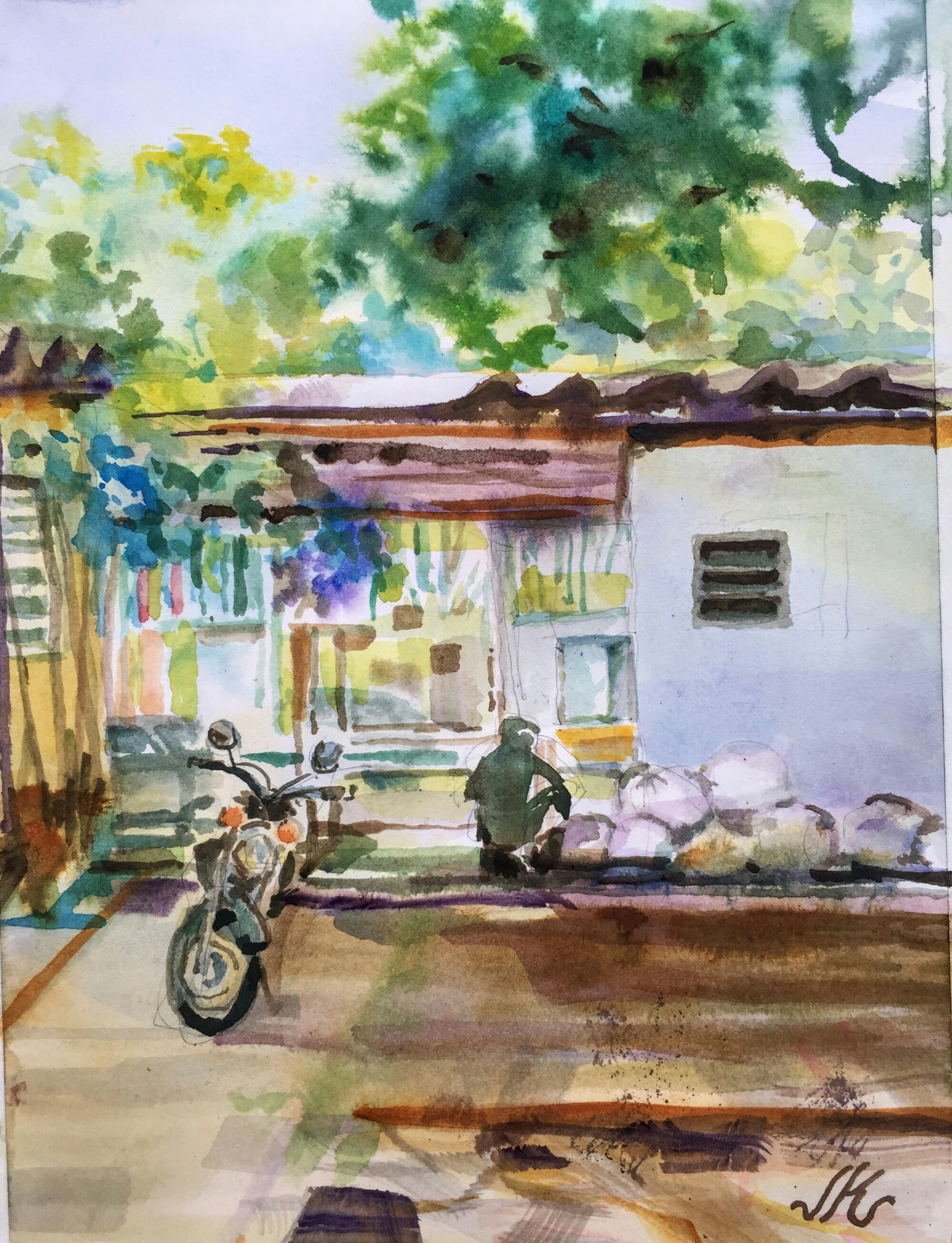
Tropical Sun and Shade, 140# h0t press watercolor paper
A couple years ago when I decided to paint with watercolors I found a book by Tom Hoffaman, Watercolor Painting, 2012, http://hoffmannwatercolors.com. I got a digital copy of it and refer to it frequently. Tom put out a post today about his upcoming teaching schedule for this and next year so I checked out his blog. Reading it led to the painting above.
Tom is very clear-headed in his approach to painting, suggesting that all paintings initially be directed by identifying the value, wetness, composition and color of the topic at hand and then consciously proceeding with these attributes as guides for subsequent painting. He says to place each brushstroke with purpose. That advice has resonance with me. I did a lot of architectural drawing at one point in my zigzag career and remember I well that an architectural drawing has NO superfluous marks, that every line must mean something.
Thinking on this, I did today’s painting and am pretty happy with it. Remaining mindful and attentive to each movement of the brush, how much paint and water to apply and keeping the total design in mind works way better than letting it rip in any ole direction.
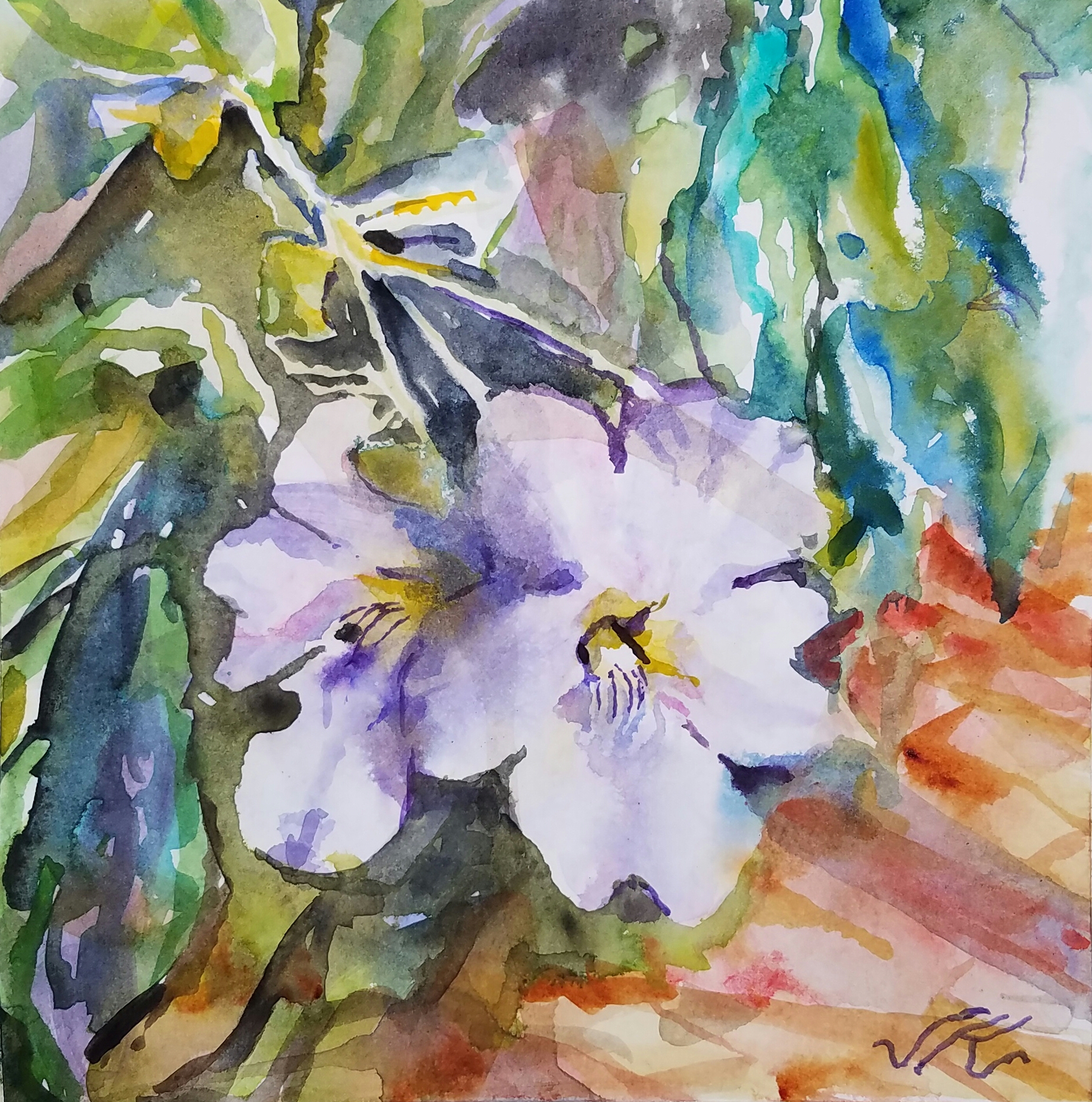
Tumbergia de Sara, 8×8″, watercolor on 140# hot press ppape
The time changed overnight in Campinas, Brazil. Now it’s much hotter earlier in the day as the spring moves toward summer here.
I painted a tumbergia, a very long and thick vine which has spread to shade the entire south patio of our apartment. Their flowers tend towards a purplish cobalt color in very, very light shades. Five petals circle a deep yellow-green center from which fine purple stripes emerge. They seem not to have much fragrence.
More info:
Humidity is often high along the imaginary circular line which is the Tropic of Capricorn . As I write it is 86% humidity in Campinas, Brazil. In Phoenix, AZ, where I was a week ago humidity is just 27%. Why should I notice or care about the difference?
I notice and care because the paper I paint on, that being Fluid 300 140# hot press, behaves much differently between locations. Here in Campinas it retains water longer and seems to diffuse into smaller, finer capillaries. Also, the pigment stays workable longer because it dries slower. The paper feels a bit moist to the touch even when ‘dry’ and this makes the colors appear brighter than in, say, Arizona, USA. Perhaps the paint will dry and lighten when back in the US but for now I’m thrilled with the look of higher humidity.
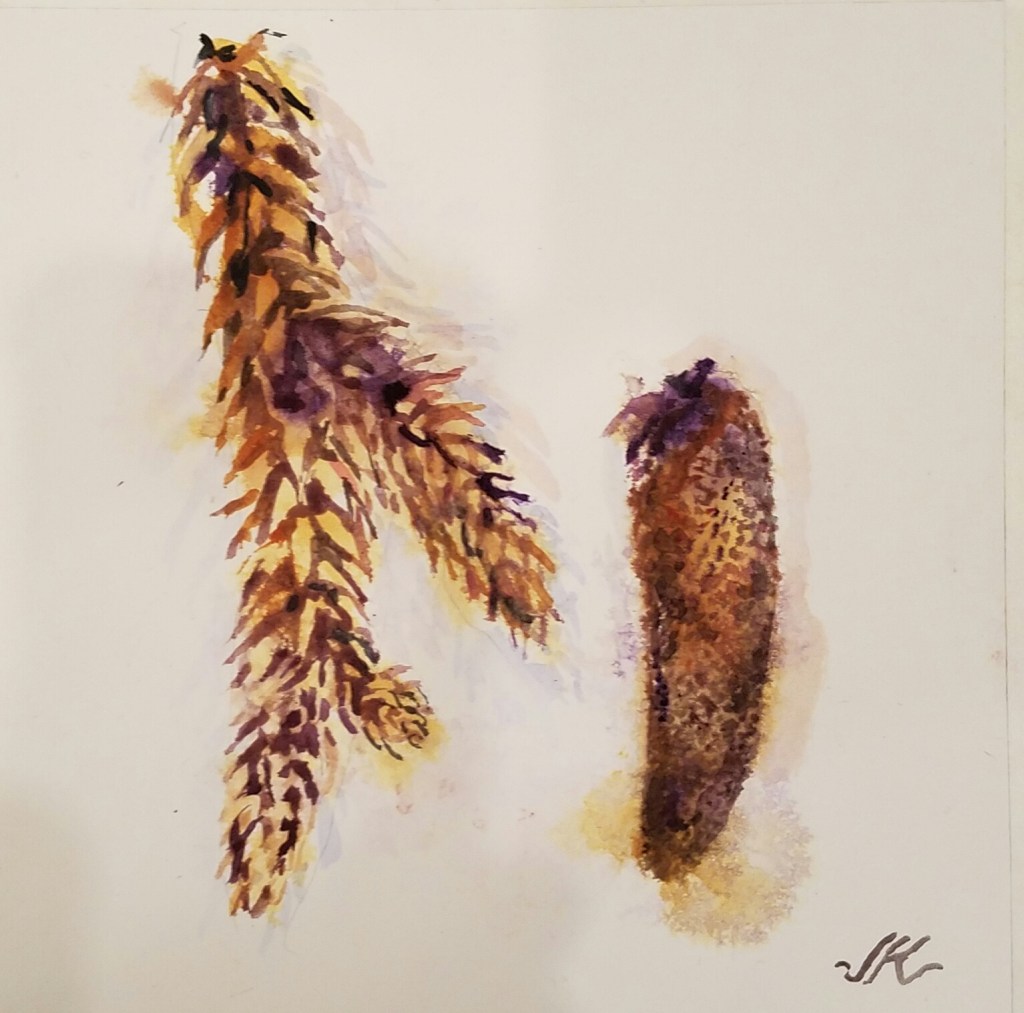
As for the more visible capillary diffusion, that effect will remain in drier climates, I think. I like the delicacy of it. Here are two examples of the difference in pigment diffusion as well as yesterday’s painting, a study of a conifer branch and cone of a variety I’ve never seen before.
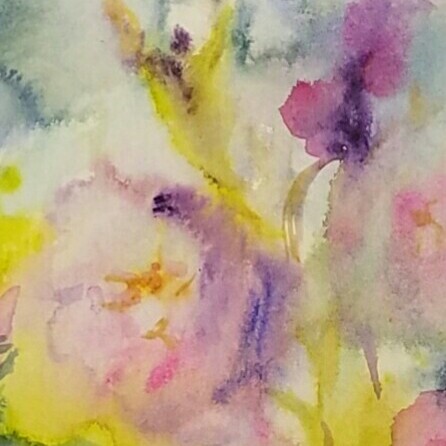
Diffusion of pigment at low humidity
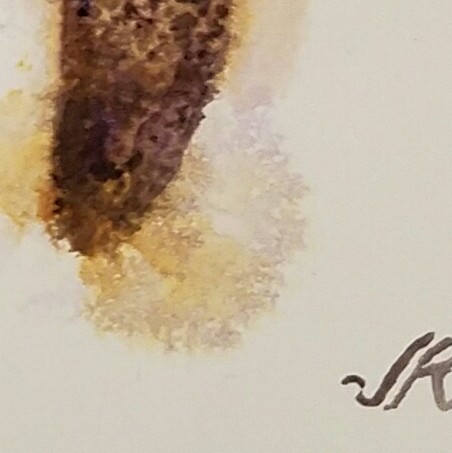
Diffusion of pigment at high humidity
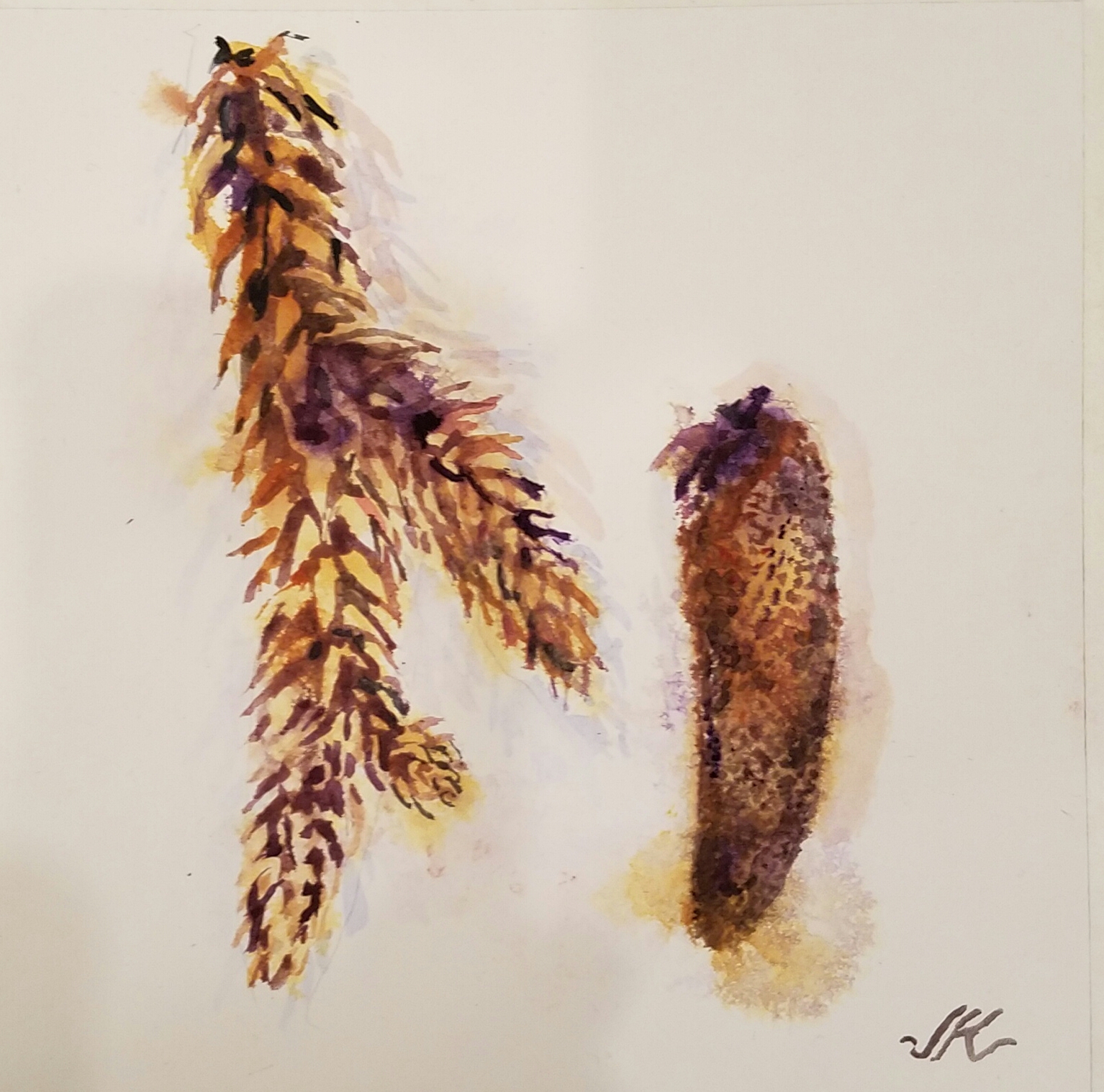
Conifer, 8 x 8″, 140# hot press watercolor paper
Most folks probably know this already but the Tropic of Capricorn (TofC) moves about 15 meters north every blessed year, just when I’d started to think some things are constant. This fact has something to do with earth’s tilt as it orbits the sun…it’s really far beyond my reckoning.
These seeds and pods were on the ground close to the yet unknown (by me) tree from which they fell. I want to identify the tree and paint more info w/re to it. I like the wavey visual movement of the pods and the seeds are too tidy to be true.
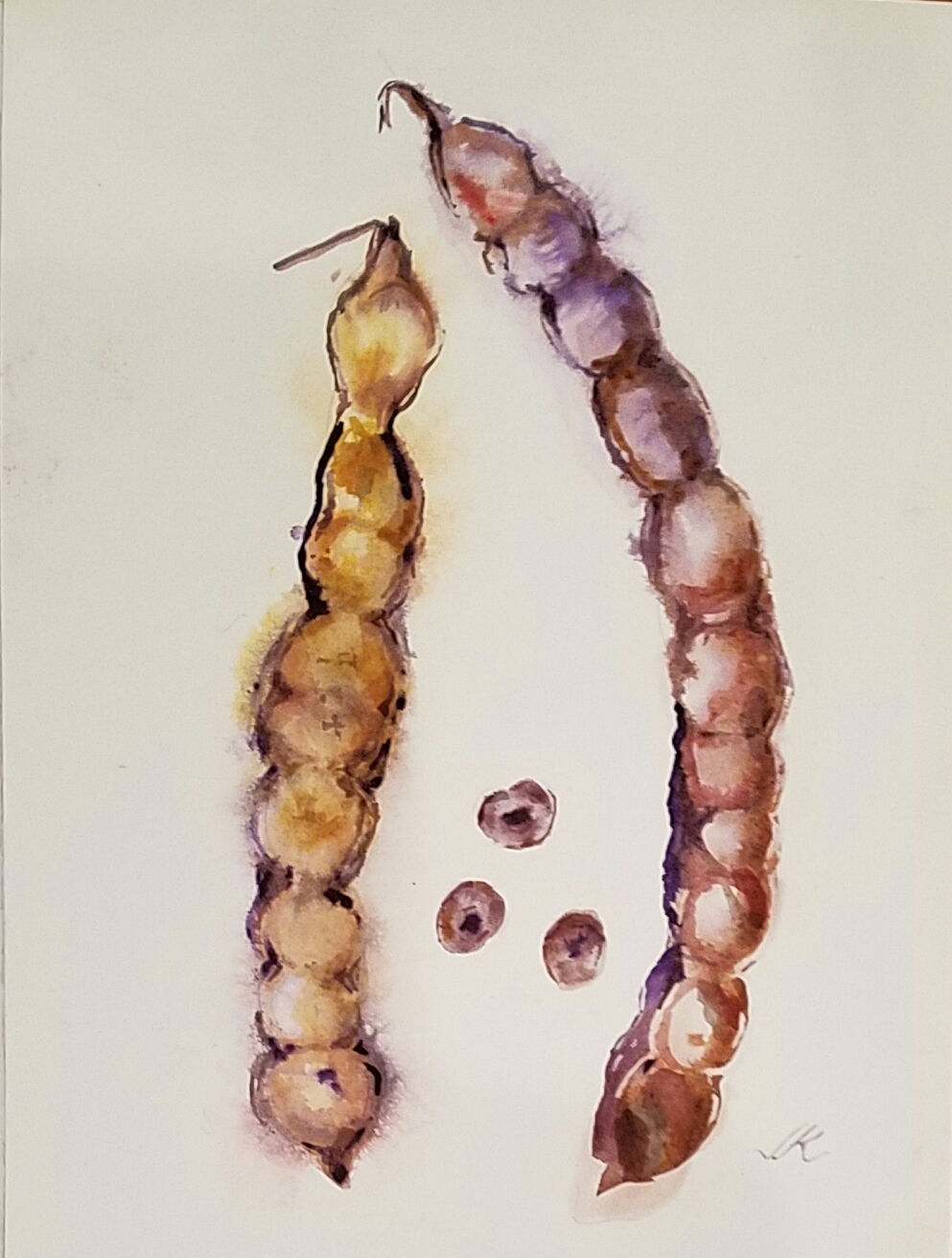
Seeds and Pods, 12×9″, watercolor on 140# HP watercolor paper


 Jean Krueger Fine Art